
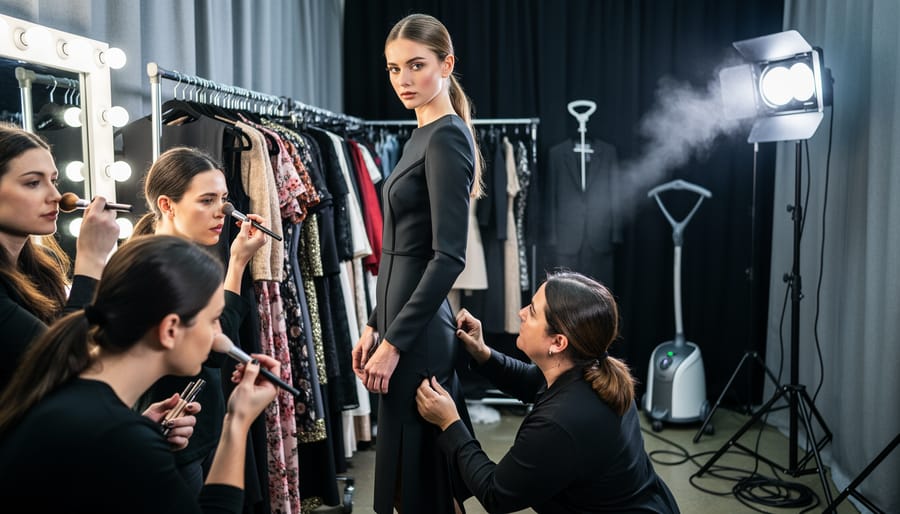
Behind every runway moment at New York Fashion Week lies a backstage world most people never see: a high-energy blur of dressers securing hemlines in seconds, makeup artists blending foundation under strobe lights, and production teams coordinating hundreds of moving pieces across a six-hour window. Understanding this hidden ecosystem reveals how New York’s fashion scene actually operates, who makes the magic happen, and why the city’s backstage culture differs from Paris, Milan, or London.
Backstage isn’t glamorous. It’s organized chaos. Models rotate through hair, makeup, and fitting stations in strict sequence while stylists troubleshoot wardrobe malfunctions and photographers negotiate access with publicists. The physical space is usually cramped, often a curtained-off area or converted loading dock where 50 to 100 people work in overlapping shifts. Timing is everything: a single 15-minute runway show requires four to six hours of prep, with call times starting as early as 5 a.m.
What sets New York apart is its democratic energy. You’ll find emerging designers sharing backstage crews with established houses, indie makeup brands working alongside legacy names, and teams that reflect the city’s diversity in ways other fashion capitals are still catching up to. The pace is faster, the budgets tighter, and the problem-solving more inventive.
This behind-the-scenes world operates on unspoken codes, strict hierarchies, and genuine collaboration. Whether you’re dreaming of working in fashion or simply curious about what happens before that first model steps into the lights, the mechanics and culture of backstage reveal how creativity and logistics collide under pressure.
The Backstage Ecosystem: Understanding the Space and Flow
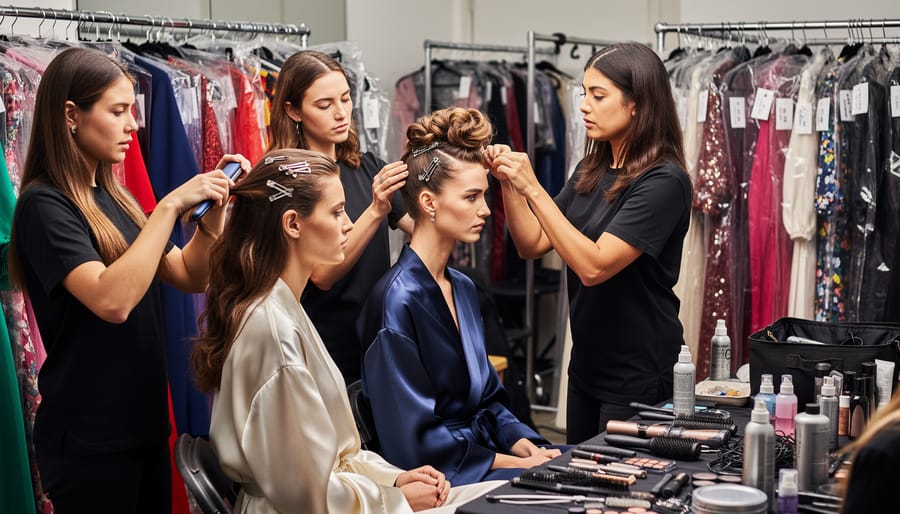
Walk into any New York Fashion Week backstage area and you’ll encounter controlled pandemonium packed into whatever space the venue offers. Unlike purpose-built fashion capitals with dedicated runway facilities, New York designers work with what Manhattan provides: industrial lofts in Chelsea, raw warehouse spaces near the Hudson, converted photography studios, and occasionally hotel ballrooms. This reality shapes everything about how backstage operates.
The layout follows a universal logic born from necessity. Every backstage divides into distinct zones, each with its own rhythm and purpose. The hair station typically claims one corner, lined with mirrors, styling tools, and products stacked on every available surface. Next to it, the makeup area buzzes with artists working at portable stations, their kits spread across folding tables. The dressing zone occupies the largest footprint, where racks of garments hang in show order with models’ names taped above each look. Finally, the staging area sits closest to the runway entrance, a transitional space where models line up, last-minute adjustments happen, and the show producer coordinates the walk order.
At Spring Studios in Tribeca, designers work with generous, column-free floors that allow proper zone separation. Teams can spread out, establish clear pathways between stations, and models can move through each phase without bottlenecking. Contrast that with Pier 59 Studios, where backstage often unfolds in segmented rooms connected by narrow hallways, forcing coordinators to orchestrate traffic flow like air traffic controllers. Pop-up venues present the wildest variables: a SoHo gallery might offer soaring ceilings but zero storage, while a Meatpacking District event space could have concrete pillars interrupting sightlines and limited electrical capacity for dozens of styling tools running simultaneously.
Designers adapt by sending advance teams to map the space days before the show. They measure, plan equipment placement, and identify choke points. Some bring portable partitions to create privacy in open spaces. Others negotiate for additional rooms when the primary backstage area proves too small for their cast size. The scrappiness required in New York’s real estate reality has made its backstage crews exceptionally resourceful, able to execute world-class shows in conditions that would paralyze less experienced teams.
The Cast: Who Makes the Magic Happen Behind the Curtain
The Creative Directors: Hair and Makeup Teams
Lead hair stylists and makeup artists serve as visual translators, taking a designer’s conceptual vision, often described in abstract terms like “ethereal warrior” or “90s grunge meets minimalism”, and turning it into concrete techniques that can be replicated across thirty models in under two hours.
The collaboration starts weeks before the show. Key artists meet with designers to discuss the collection’s mood, review fabric swatches, and sketch potential looks. At New York shows, this process reflects the city’s diverse talent pool. Teams routinely include stylists trained in textured hair techniques alongside specialists in sleek, straight styles. Makeup artists stock foundations spanning 50+ shades as standard practice, not afterthought.
During these creative sessions, lead artists might propose adjustments based on practical realities: a hairstyle that works on straight hair but tangles coarse curls, or a makeup concept that photographs poorly on deeper skin tones. The best collaborations happen when designers trust their teams to adapt the vision for different faces and textures while preserving the overall aesthetic.
This inclusive approach, born from New York’s multicultural reality, has become the city’s backstage signature, beauty looks that celebrate variety rather than forcing uniformity.
The Dressers and Wardrobe Coordinators
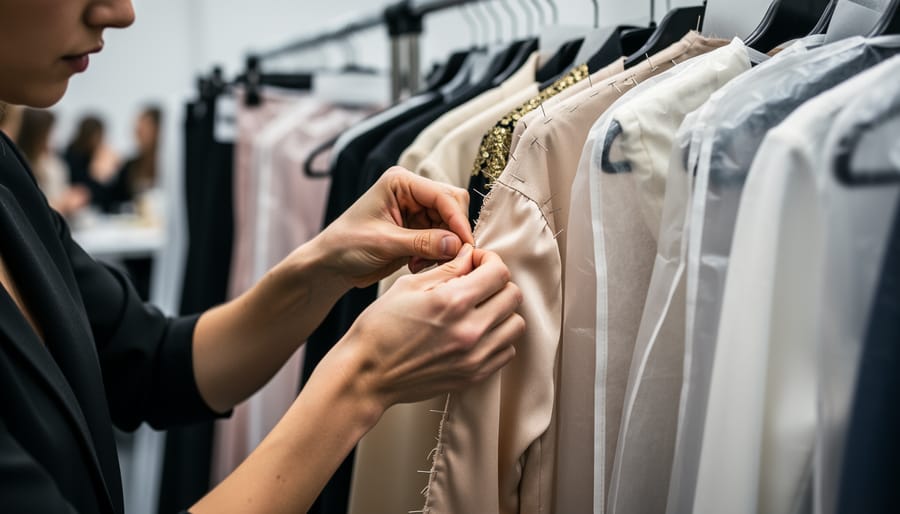
Dressers work as the invisible force keeping runway chaos from erupting. They’re responsible for hanging and organizing every garment in the exact order each model will wear it, creating a system that can survive the panic of a 15-show-day schedule. Each piece gets tagged with the model’s name, look number, and any accessories that complete the outfit, a method that prevents the nightmare scenario of a dress walking out without its matching belt or jewelry.
Quick changes demand surgical precision. When a model has 90 seconds between looks, dressers unzip, unhook, and re-dress at speed while keeping expensive garments intact. They memorize which direction zippers run, how closures fasten, and which pieces need extra care. A skilled dresser can execute a complete outfit swap in under a minute without damaging delicate fabrics or disrupting hair and makeup.
The real skill shows during emergencies. Broken zippers get safety-pinned. Hems that come loose get tacked with needle and thread between looks. If a model’s measurements changed since fittings, dressers adjust fit on the spot. They carry kits stocked with fashion tape, safety pins, scissors, and spare buttons, the tiny tools that save million-dollar collections from disaster.
Models: Navigating the Backstage Marathon
For models, backstage at New York Fashion Week is a test of physical endurance and mental focus. They arrive knowing only approximate call times, often juggling three or four shows in a single day across Manhattan. The reality bears little resemblance to the polished images fans see online.
Once called, models navigate a rapid-fire sequence: quick fittings to confirm garment assignments, then straight to hair and makeup chairs where they sit motionless for 45 minutes while teams work. There’s rarely catering beyond coffee and fruit, and bathroom breaks require strategic timing around hair completion. Between styling stations, models practice quick changes with their assigned dresser, memorizing the exit order and mentally rehearsing their runway acting skills to embody each designer’s specific vision.
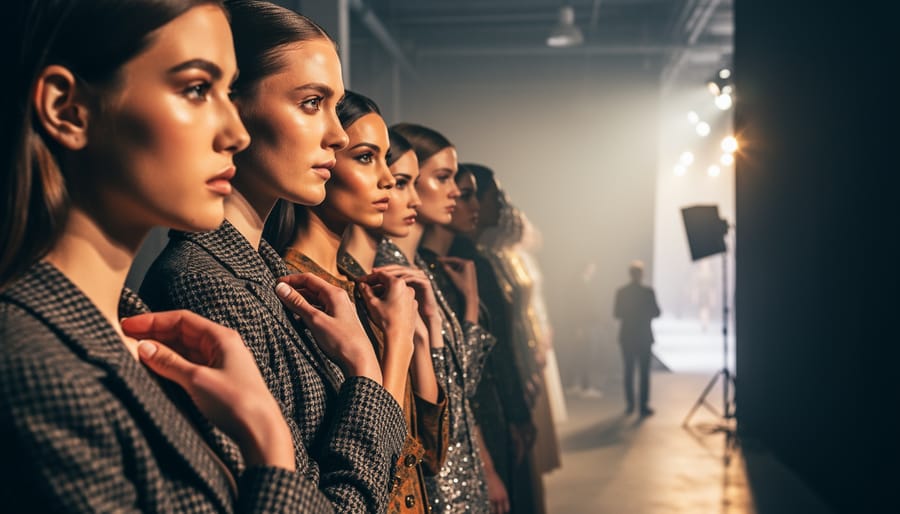
The final minutes before showtime compress into controlled chaos, last-minute alterations, touch-ups, frantic searches for missing shoes. Models stand in lineup formation, barefoot on concrete, waiting for their cue. Then it’s over in 90 seconds, and they’re racing to the next venue, still wearing someone else’s foundation.
The Timeline: How 90 Minutes Transforms Into a Show
The transformation from empty venue to runway-ready show happens in a compressed 90-minute window that feels simultaneously endless and impossibly short. Unlike Fall fashion prep which unfolds over months, backstage execution is a high-stakes sprint where every minute counts and teams operate with choreographed precision.
- T-minus 90 minutes: Arrival and SetupModels arrive, check in with production, and head straight to their assigned stations. Hair and makeup teams do final kit checks while dressers organize garments by running order. The energy is focused but not frantic yet.
- T-minus 75 minutes: Hair and Makeup BeginsLead stylists and makeup artists start on anchor models while assistants prep others. Teams work assembly-line style, moving from station to station. This is the longest segment, accommodating the detailed work required for complex looks.
- T-minus 30 minutes: First Models DressedAs hair and makeup wraps on early models, dressers begin fitting them into their runway looks. The backstage volume rises as more people finish and crowd into the dressing zone. Double-checking accessories and shoes becomes critical.
- T-minus 15 minutes: Line-Up FormationModels gather in runway order near the stage entrance. Production assistants do final checks on every detail, loose threads, smudged makeup, proper accessories. The designer often does a last walk-through, making minute adjustments.
- T-minus 5 minutes: The CalmParadoxically, the final minutes before the show often bring quiet focus. Models stand ready, teams step back, and there’s a collective held breath. Last-minute chaos has either been resolved or accepted.
- Showtime: ExecutionThe first model steps out, and backstage shifts into pure reaction mode. Dressers handle quick changes for models walking multiple looks, makeup artists fix any mishaps between exits and re-entries, and the entire team watches monitors to ensure everything reads correctly under runway lights.
This timeline rarely goes exactly as planned. A zipper breaks at T-minus 10, requiring emergency hand-sewing. A model gets stuck in traffic, throwing off the entire hair-and-makeup rotation. The designer decides to swap look 12 and look 18 at the last possible second.
What separates New York teams from others is their ability to absorb these disruptions without visible panic. The 90-minute window has built-in flexibility because experienced backstage crews anticipate problems and create workarounds on the fly, maintaining the illusion of effortless perfection that audiences see on the runway.
Challenges Unique to New York Fashion Week Backstage
Manhattan real estate doesn’t get generous just because it’s Fashion Week. Backstage crews squeeze into venues where dressing areas share square footage with electrical panels and emergency exits. Spring Studios and Pier 59 offer dedicated fashion infrastructure, but many designers show in repurposed galleries, warehouses, or event spaces where “backstage” means whatever corner isn’t visible to the audience. Hair and makeup stations get stacked tight. Garment racks overflow into hallways. Teams learn to work elbow-to-elbow, developing spatial efficiency that would impress a Tetris champion.
New York’s celebrated diverse casting creates technical demands that exceed other fashion capitals. A show featuring models with type 4C coils, fine Asian hair, thick Latina waves, and everything between requires stylists who genuinely know how to work with each texture, not just force every head into the same look. Makeup artists stock 40-plus foundation shades as standard practice now, but matching undertones under harsh backstage lighting while moving fast remains an art. The city’s reputation depends on getting this right, which means teams can’t fake expertise or reach for the same three products they’d use in Milan.
Union regulations add another layer of complexity specific to New York. Many venues require union labor for setup, lighting, and certain technical roles. Designers flying in from overseas sometimes clash with these requirements, unaware that their European crew can’t just handle everything themselves. Coordinating union and non-union workers, respecting jurisdictional boundaries, and building extra time into setup schedules becomes part of the backstage calculus.
Then there’s the designer who changes everything 90 minutes before showtime. New York’s competitive pressure pushes creative decisions right up to the wire. A model gets swapped. An accessory gets added. Suddenly the hair needs to be up instead of down, for 30 models. Backstage teams in New York have learned to treat the printed lineup as a strong suggestion rather than gospel, keeping backup plans ready and maintaining the flexibility that separates professionals from amateurs.
The Cultural Influence: How New York’s Diversity Shapes Backstage Practices
New York’s makeup stations tell the story of fashion’s evolution better than any runway. Where backstage kits once carried fifteen foundation shades, mostly clustered around lighter tones, today’s New York Fashion Week professionals arrive with fifty-plus shades spanning the full spectrum of human skin. This shift reflects the city itself, where a makeup artist might work on a model from Kenya, then immediately move to someone of Korean descent, followed by a Dominican model with different undertones entirely.
The hair stations show even more dramatic change. Stylists who once specialized exclusively in straight or wavy textures now train rigorously in protective styling, working with natural coils, locs, and braids. Major shows stock multiple texture-specific product lines rather than trying to force all hair types through the same regimen. When a designer casts thirty models representing different ethnicities, the backstage team needs actual expertise, not just good intentions, to execute cohesive looks that respect each person’s natural features.
This inclusive approach extends beyond products and skills. Backstage teams now discuss fashion accessibility in broader terms: adjustable makeup stations for models with mobility differences, clear communication protocols for models who are deaf or hard of hearing, and lighting setups that properly illuminate all skin tones for touch-ups.
The commercial impact has been undeniable. Brands that demonstrate genuine multicultural competence backstage often see that authenticity translate to consumer trust. New York’s diverse population created the market pressure, but backstage professionals turned it into craft, developing techniques that enhance rather than erase difference. What began as accommodation has become artistry, setting standards that other fashion capitals increasingly follow.
Technology and Innovation Backstage
The digital revolution has fundamentally altered how New York fashion show backstage teams operate, though not always in the ways outsiders might expect. While the artistry remains hands-on, you won’t find robots applying makeup, technology now handles the logistical nightmares that once consumed hours of coordination.
Most teams rely on shared cloud-based platforms like Airtable or custom apps to track model assignments, look breakdowns, and styling notes across dozens of phones simultaneously. When a model arrives, dressers scan her name to pull up her exact outfit sequence, accessories, and any last-minute alterations. Makeup artists photograph each completed face to ensure consistency if touch-ups are needed post-runway. Hair teams document angles of every style, creating instant reference libraries that prevent miscommunication when four stylists are replicating the same intricate updo.
Social media has added another layer of complexity. Designated content creators now weave through backstage capturing behind-the-scenes footage while production assistants enforce strict “no phones” zones to prevent leaks. Some designers livestream prep work directly to followers, turning backstage access into marketing gold.
Despite these advances, the core work hasn’t changed. Technology streamlines communication and documentation, but the speed and artistry still depend on experienced hands who can pin a dress in fifteen seconds or blend foundation on the move. The tools enhance human expertise; they don’t replace it.
Common Questions About Fashion Show Backstage Life
How do people get backstage access to New York Fashion Week shows?
Most backstage access is strictly credential-based, limited to working professionals (stylists, makeup artists, dressers, photographers) hired for that specific show, plus essential brand team members and selected media with backstage passes. General attendees and front-row guests stay in designated areas and don’t enter working backstage zones during show preparation.
What career paths lead to backstage work at fashion shows?
Most backstage professionals start by assisting established hair stylists or makeup artists, working fashion retail or styling jobs, or graduating from fashion programs with internships. Building a portfolio, networking at smaller shows and photo shoots, and demonstrating reliability under pressure opens doors to assisting at Fashion Week, which can lead to lead roles over several seasons.
Is backstage really as glamorous as it looks on social media?
The reality involves long hours standing on concrete floors in cramped, overheated spaces with minimal breaks, equipment scattered everywhere, and constant time pressure. While the creative energy and final results are exciting, the working conditions are physically demanding and far less polished than the curated behind-the-scenes content suggests.
Do backstage teams work multiple shows during Fashion Week?
Yes, many hair and makeup artists work several shows per day during the week, racing between venues with their kits. This requires meticulous planning around show times, quick wardrobe transition between looks, and the stamina to maintain quality while managing back-to-back 12-hour days.
These questions reflect what aspiring professionals and fashion enthusiasts most want to understand about breaking into and surviving in this demanding environment. The gap between perception and reality is significant, social media highlights the artistry and excitement while downplaying the physical toll and years of groundwork required to earn a spot on these teams. Understanding these realities helps anyone considering this career path set appropriate expectations and prepare for the commitment the work demands.
The runway lights illuminate finished looks that represent months of preparation, but the real story of New York Fashion Week lives in those final chaotic minutes backstage. What audiences see as a seamless ten-minute spectacle is actually the product of dozens of specialists executing their craft with split-second timing, transforming creative vision into tangible reality under intense pressure.
This world thrives on collaboration. A hairstylist’s quick fix enables a makeup artist’s final touch, which allows a dresser to complete the outfit just as the model steps toward the runway. When one element falters, the entire chain reacts and adapts. That resilience, built on mutual trust and shared expertise, defines New York’s backstage culture.
The diversity of talent behind the curtain has reshaped industry standards, pushing fashion toward practices that honor different beauty traditions rather than erase them. The professionals who stock inclusive product ranges, master varied techniques, and advocate for authentic representation do more than prep models, they actively expand what fashion celebrates.
Next time you watch a runway show, consider the unseen choreography that made it possible. The precision of a dresser managing fifteen-second changes. The cultural knowledge a makeup artist brings to foundation matching. The stamina of a model navigating five shows in one day. These professionals transform abstract concepts into moments that influence global style, and their contribution deserves recognition equal to what walks down that runway.