

Backstage acting jobs in the modeling world refer to the performance skills models use offstage to navigate high-pressure fashion environments, from casting calls to backstage runway prep. These aren’t traditional acting roles, but rather the ability to embody confidence, manage nerves, take direction fluidly, and adapt your persona to match a designer’s vision or photographer’s brief. The most successful models in 2026 treat every interaction as a micro-performance: they read the room, adjust their energy, and deliver the exact vibe a creative team needs without being asked twice.
Think of backstage as theater without an audience. You’re collaborating with stylists who might be running on two hours of sleep, makeup artists working against brutal deadlines, and casting directors evaluating dozens of faces in minutes. Your ability to stay composed, take feedback without defensiveness, and project the right attitude can determine whether you’re remembered or overlooked. Models from Lagos to Milan have shared stories about losing jobs not because their look was wrong, but because they couldn’t handle the controlled chaos backstage or failed to connect with the team.
This performance layer isn’t about pretending to be someone you’re not. It’s about understanding that modeling demands emotional intelligence, quick character shifts, and the same presence actors cultivate. Whether you’re brand new to the industry or refining your craft, strengthening these backstage acting skills opens doors that physical appearance alone never will.
What ‘Backstage Acting’ Really Means in Modeling
When you hear “backstage acting jobs” in a modeling context, forget the audition monologues and method acting exercises. This isn’t about landing a role in a film or theater production. Instead, backstage acting in modeling refers to the performance skills you deploy during the unglamorous, high-pressure moments that happen before, between, and after your runway appearances, when no audience is watching, but everyone is evaluating you.
Think of it as controlled professionalism under chaos. During a fifteen-second quick change, while three people pull clothes over your head and swap your shoes, you project calm confidence even though your heart is racing. When a designer explains their abstract vision for the collection, something about “embodying the spirit of a forgotten garden at twilight”, you nod thoughtfully and translate that poetry into posture, expression, and energy. When a zipper breaks two minutes before you walk, you maintain composure while the team scrambles for a solution, never letting panic show on your face.
This performance differs sharply from traditional acting. You’re not inhabiting a fictional character with dialogue and a storyline. You’re amplifying your professional self, becoming the most composed, adaptable, and collaborative version of yourself under conditions designed to test those exact qualities. The theatrical element lies in maintaining this performance consistently, projecting energy when exhausted, appearing effortless during complicated choreography, and staying gracious when feedback feels harsh.
During fittings, you become a living canvas, reacting to garments with your body language and subtle expressions, helping designers see their vision come to life. You’re performing interest, enthusiasm, and understanding, even when standing still for thirty minutes while someone pins fabric. This backstage theater happens in cramped tents, hotel rooms converted to dressing areas, and studio spaces worldwide, anywhere the real work of fashion unfolds away from the spotlight.
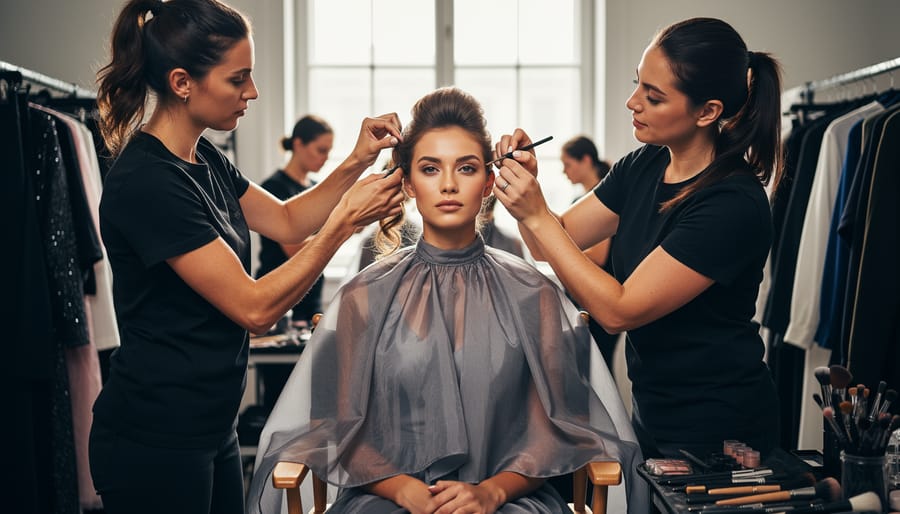
The Performance Skills Models Use Behind Closed Doors
Reading the Creative Director’s Vision
You’re standing backstage while a creative director gestures wildly, describing the collection as “raw vulnerability meets industrial strength” or “a conversation between shadow and light.” There’s no script, no literal translation, just abstract concepts you need to translate into body language, facial expression, and energy within minutes.
This is where models become interpreters. You’re listening for mood words, watching the designer’s hands, noting the music they reference. When they say “angry,” do they mean fierce confidence or chaotic rebellion? You’re scanning the garments for clues, structured shoulders might demand sharpness, while flowing fabrics whisper softness.
During backstage rehearsals, you test interpretations. Walk with slightly more tension. Soften your gaze. Lift your chin differently. The creative team’s reactions, a nod, a “yes, that!”, guide your adjustments. You’re essentially auditioning variations of a character until you land on what brings their vision to life.
Models who nail this skill get invited back. They’re not just wearing clothes; they’re embodying stories. The best understand that creative directors aren’t always articulate about what they want, they need you to feel it, interpret it, and perform it without them spelling out every detail.
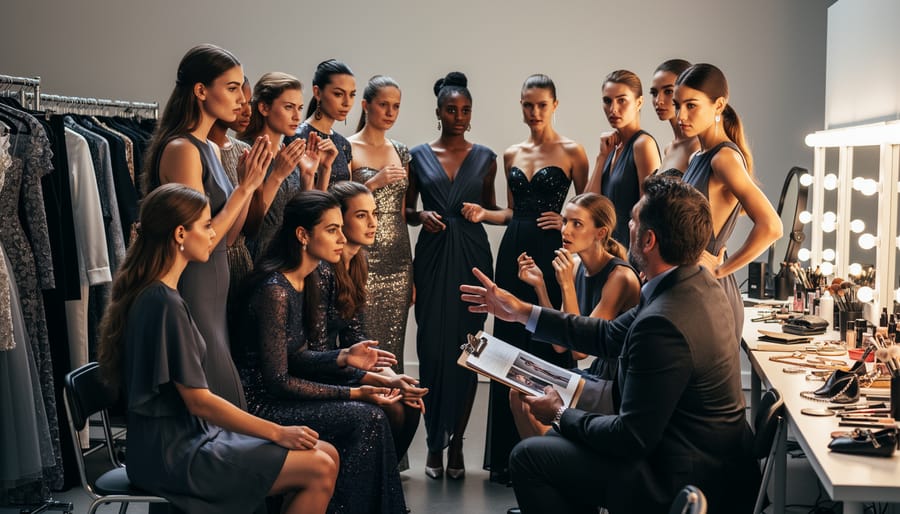
The Quick-Change Performance
Quick changes are pure theater, thirty seconds to strip, redress, and mentally reset between looks while three dressers swarm around you. You’re standing in your underwear as someone yanks a garment over your head, another fixes your hair, and a third adjusts jewelry, all while you hold your center and breathe. The performance here isn’t physical stillness; it’s emotional control. Panic shows on your face, and it carries onto the runway.
The best models treat quick changes like stage actors treat costume transitions, they’ve rehearsed the sequence mentally, they know which side to enter from, and they’ve practiced staying in character even mid-transformation. You’re not just a mannequin being dressed; you’re actively participating, shifting your weight on cue, lifting arms without being asked, and maintaining the energy level the show demands. A couture show in Paris might require graceful cooperation during intricate fastenings, while a streetwear show in Seoul expects you to embody urban edge through the entire change, even while half-dressed.
This backstage choreography reveals who’s truly professional. Models who resist the chaos or mentally check out create delays and tension. Those who perform calm competence, who smile at their dresser, stay present, and snap back into showtime instantly, become the ones designers request again.
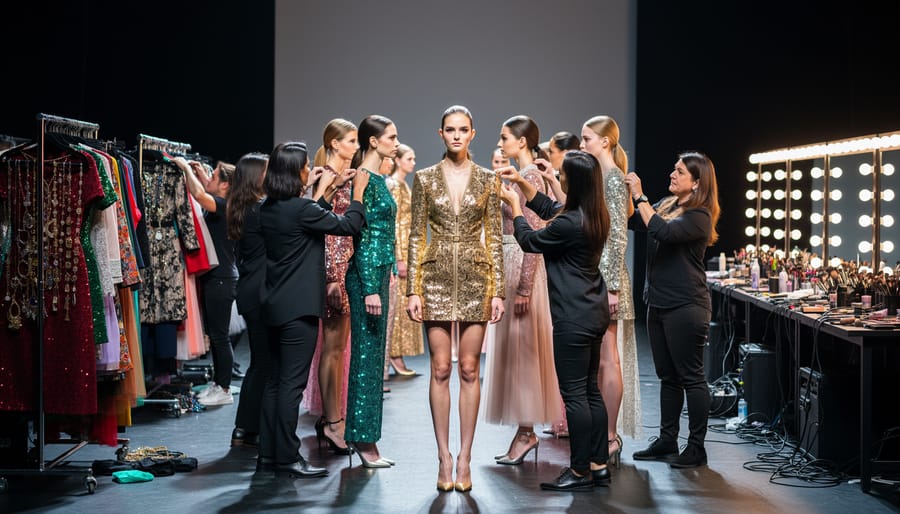
When Models Become Backstage Performers: Real Scenarios
Picture this: 15 minutes before showtime at Milan Fashion Week, the creative director scraps the entire opening sequence. You’re no longer third in the lineup wearing emerald silk, you’re now opening the show in a structured avant-garde piece you’ve never tried on. Your heart’s racing, but your face stays serene. You nod, smile, and project absolute confidence as three dressers descend on you. This is where your backstage acting becomes career-defining.
During Shanghai Fashion Week 2025, model Chen Wei witnessed a makeup artist accidentally smudge liquid liner across a model’s cheek minutes before her cue. The model didn’t panic or freeze. She maintained her breathing, stayed perfectly still during the frantic fix, and walked out on time with full composure. That ability to perform calm under genuine crisis? That’s backstage acting in its purest form.
Wardrobe malfunctions test your improvisational skills like nothing else. When a zipper breaks during a Paris couture presentation, you can’t stop the show. Models learn to hold garments together with strategic hand placement, adjust their walk to accommodate loose hems, or even perform subtle movements that disguise construction failures, all while selling the designer’s vision with their face and energy.
The dynamics shift dramatically across fashion capitals. In New York, backstage chaos often carries a collaborative, problem-solving energy. Models report feeling more comfortable asking questions or suggesting solutions. London’s independent designer shows sometimes blur the line between model and creative partner, with performers expected to contribute ideas during rehearsals. Tokyo’s backstage environments typically demand more formal deference to hierarchy, where reading unspoken cues becomes essential. Lagos Fashion Week, meanwhile, often celebrates a warmer, more communal backstage culture where experienced models mentor newcomers through the chaos with humor and encouragement.
Then there’s the delicate performance of navigating difficult personalities. When a photographer snaps at you during a backstage editorial shoot, your professional mask stays on. You take direction without defensiveness, adjust your energy to match their intensity, and demonstrate flexibility that makes you the easy choice for their next booking.
Brazilian model Sofia Ramos recalls her breakthrough moment during São Paulo Fashion Week when the lead stylist was clearly overwhelmed. Sofia didn’t wait for instructions, she read the room, anticipated needs, and helped newer models navigate the chaos. Her backstage performance of calm leadership caught the attention of three designers who booked her for their upcoming campaigns. She wasn’t hired for her walk. She was hired for her presence when no one was watching.
Training Your Backstage Performance Skills
The good news? These backstage performance skills aren’t mystical talents you’re born with. They’re learnable abilities you can develop through consistent practice, just like perfecting your walk or mastering angles for the camera.
Start by borrowing from the theater world. Actors spend years training their instrument, their body, voice, and emotional presence, and models can benefit from the same foundational work. Consider taking an introductory acting class or workshop, not to become a film star, but to understand character work, emotional access, and physical awareness. Many successful models in Milan and London credit acting workshops with helping them embody designer concepts more authentically during fittings and shows.
Mindfulness practices offer another powerful training ground. The backstage environment demands that you stay present despite distractions, exhaustion, or anxiety. A regular meditation practice, even just ten minutes daily, builds your capacity to remain centered when a dresser is pulling at your clothes while someone else adjusts your hair and the show director is shouting instructions. Breathing exercises are particularly valuable, learning to consciously slow your breath when you feel overwhelmed can transform your backstage presence within seconds.
Here are practical exercises you can start today to strengthen your backstage performance skills:
- Mirror work with emotional shifts: Stand before a mirror and practice moving between neutral calm and various emotional states (confidence, approachability, intensity) while maintaining physical composure. This builds your ability to project different energies on command during fittings and rehearsals.
- Quick-change drills at home: Time yourself changing outfits rapidly while maintaining grace and composure. Practice staying mentally present rather than panicking about speed, this directly translates to backstage transformations.
- Sensory grounding exercises: In stressful moments, practice the 5-4-3-2-1 technique (identify five things you see, four you can touch, three you hear, two you smell, one you taste). This keeps you present when backstage chaos threatens to overwhelm you.
- Role-playing difficult scenarios: With a friend or fellow model, practice challenging backstage interactions, receiving critical feedback gracefully, adapting to sudden changes, or working with demanding personalities. Rehearsing these moments removes their power to derail you.
- Physical awareness exercises: Practice walking, standing, and moving in your daily life as if you’re being observed with the same attention you’d receive backstage. Notice how your body holds tension, where you collapse or compensate, and consciously adjust.
The key is treating these exercises as seriously as you’d treat learning a new runway walk. Schedule them into your week, track your progress, and notice how your confidence grows in actual backstage environments. Many models in Tokyo and Seoul incorporate these practices into their morning routines, viewing backstage performance training as essential career maintenance rather than optional extras.
The Business Side: How Backstage Acting Builds Your Modeling Career
Strong backstage performance directly translates into career longevity in ways that a perfect runway walk alone never will. Designers and casting directors remember the model who remained gracious during a chaotic fitting, not just the one who photographed well. These interactions build the professional reputation that generates repeat bookings season after season.
When you handle backstage pressure with composed professionalism, you become what industry insiders call a “safe bet.” Fashion houses don’t just book models for their measurements, they book them for reliability. A model who can maintain positive energy during twelve-hour fitting days, adapt to last-minute creative changes without complaint, and treat every team member with respect becomes invaluable. This reliability matters more than most aspiring models realize. A designer might have fifty models who technically fit the brief, but they’ll repeatedly choose the handful who made their backstage experience smoother.
Your backstage behavior also determines whether you get upgraded from smaller shows to flagship presentations. Stylists and creative directors talk. One professional backstage performance at a smaller brand’s show can lead to a recommendation for a major fashion week presentation. Conversely, one moment of visible frustration or unprofessional behavior backstage can close doors you didn’t even know existed.
The economic reality is straightforward: models who excel backstage work more consistently. They’re the ones called for direct bookings without auditions because their reputation precedes them. They maintain relationships with photographers and brands across multiple seasons. In 2026’s competitive modeling landscape, where thousands of new faces emerge annually, your backstage performance skills become your career insurance. The model who treats fittings as performances, maintaining character, reading the room, and delivering professionalism even when exhausted, builds a sustainable career rather than just collecting a few impressive tearsheets.
Navigating Different Backstage Cultures Worldwide
Fashion’s backstage environments carry distinct cultural fingerprints that shape how you need to perform your professionalism. Understanding these differences before you arrive means adapting your energy, communication style, and expectations to match each city’s unspoken rules.
| Fashion Capital | Backstage Pace | Formality Level | Key Expectations |
|---|---|---|---|
| Milan | Structured, punctual | Professional, respectful | Quiet confidence, family-brand loyalty |
| Paris | Measured, traditional | High formality | Discretion, understated elegance |
| New York | Fast, energetic | Casual professionalism | Efficiency, friendly adaptability |
| London | Creative chaos | Relaxed but focused | Humor, collaborative spirit |
| Tokyo | Meticulous, precise | Very high formality | Respectful silence, exact positioning |
New York backstage thrives on hustle and friendly banter. Models chat with dressers, energy stays high, and showing enthusiasm helps you fit in. The pace demands quick thinking and visible teamwork. In contrast, Paris couture shows expect quiet reverence for the craft. You’ll notice models speaking softly, waiting to be addressed first, and treating garments with ceremonial care. The formality isn’t coldness, it’s respect for heritage.
Milan sits between these extremes. Italian fashion houses value punctuality and professional distance, but warmth emerges once you’ve proven reliability. Long-term relationships matter more than one-season friendships. Tokyo’s backstage culture demands the most adaptation for Western models: precise positioning during fittings, minimal casual conversation, and deep bows to show gratitude. Your performance here centers on respectful stillness rather than animated engagement.
London’s backstage vibe channels creative irreverence, expect spontaneous problem-solving, designers joining the chaos, and dark humor relieving tension. Models who can laugh at mishaps while staying focused thrive here. The skill isn’t choosing one performance style but reading each environment quickly and adjusting your backstage character to honor local norms while staying authentically professional.
The runway walk lasts seconds. The backstage performance can span hours. Understanding this reality transforms how you approach every casting call, fitting, and show day in 2026’s modeling industry.
Every time you maintain composure during a chaotic quick change, you’re acting. When you embody a designer’s abstract vision during rehearsal, you’re performing. These moments aren’t interruptions to the real work, they are the real work. The most successful models recognize that their backstage presence carries as much professional weight as their runway stride.
These skills aren’t reserved for naturally confident extroverts or theater graduates. Emotional regulation, spatial awareness, and professional adaptability are abilities you build through practice and intention. Every backstage experience offers another opportunity to refine your performance toolkit, regardless of whether you’re walking your first local show or your fiftieth international runway.
Start viewing each backstage moment as your audition for the next booking. The designer watching you handle stress with grace during fittings is already deciding whether to request you again. Your backstage acting shapes your reputation, opens doors, and ultimately defines your modeling career just as powerfully as your portfolio ever could.